- Lectures and Symposiums
Bringing manga to the museum: Talk by curator Rei Yoshimura @ Japan House London
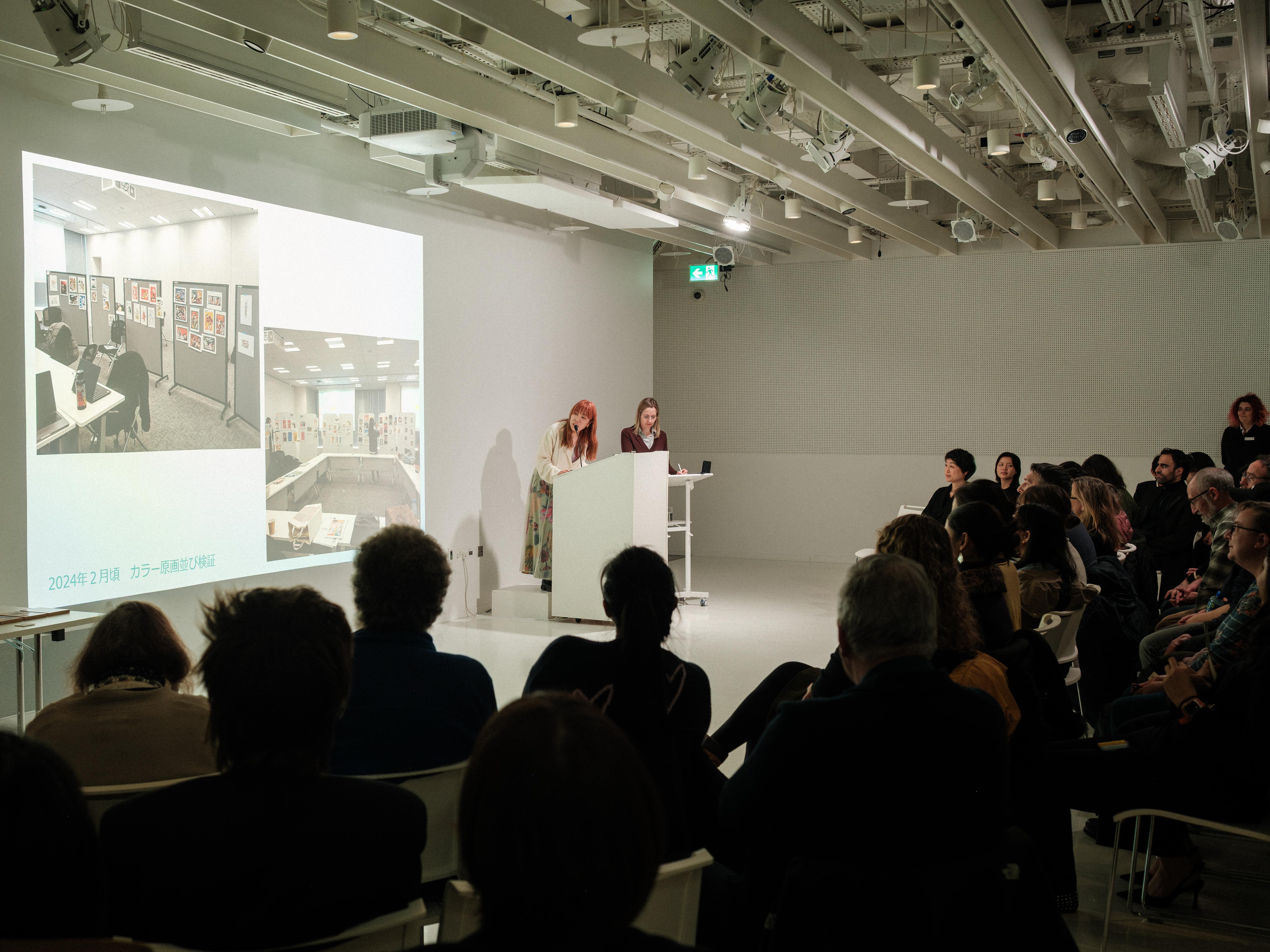
In January 2026, ahead of the opening in October 2026 of Shojo Manga Infinity: Moto Hagio, Ryoko Yamagishi, and Waki Yamato, the National Art Center, Tokyo held talk events in London and Paris featuring Rei Yoshimura, a curator at the NACT and one of the few researchers who specialize in this field.
The talks took place in the cities where MANGA⇔TOKYO (La Villette, 2018) which the NACT had organized, and Manga (the British Museum, 2019) whichthe NACT had been deeply involved in planning, were previously held. In conversation with local specialists, Yoshimura discussed how to bring manga to the museum and the diverse world of shojo manga.
Long confined to the status of popular entertainment, manga has gradually established itself as one of the central visual languages of contemporary Japan. Its entry into cultural institutions, however, has taken place in stages, shaped by debates and delicate negotiations between museums, publishers, and scholars. It is this deeper movement, observed from within the institutions themselves, that Rei Yoshimura, curator at the National Art Center, Tokyo, set out to examine in a lecture held at Japan House in London.
After an outline of the evening’s program by Shotaro Okada, Programming Officer at Japan House London, delivered to a full audience, Ko Miryon, Senior Manager in charge of international projects at the National Art Center, Tokyo, looked back over Rei Yoshimura’s career. A specialist in manga studies, she began her career as a curator in the manga department of the Kawasaki City Museum from 2014 to 2017. She then joined the National Art Center, Tokyo, as a visiting researcher in 2017, before taking up her current position there in 2021.
She opened with an observation that borders on paradox: in Japan, there are still very few curators capable of firmly embedding manga within art history. This shortage is not trivial. It reflects, indirectly, the status long assigned to manga: first children’s entertainment, then a mass-consumption product, before becoming a visual language shared across generations. “In Japan, manga is everywhere,” Rei Yoshimura reminded the audience, and it is precisely this familiarity that makes it difficult to conceptualize manga as a museum object.
“If we look at the development of manga studies,” she explained, “in the postwar period manga was still regarded as children’s entertainment, and there was very little academic research devoted to it. In the 1970s, as manga grew in popularity, forms of criticism and analysis began to emerge. In the 1980s, private research groups were established, and manga started to be addressed in university courses on social and cultural history. But what truly contributed to the expansion of manga studies and research was the gradual creation of manga departments within public museums.”
To understand how museums began to take hold of manga, Rei Yoshimura pointed to a key institutional milestone: in 1990, The National Museum of Modern Art, Tokyo organized a major exhibition devoted to Osamu Tezuka, a central figure of postwar narrative manga and often referred to in Japan as the “god of manga.” For the first time, a national museum treated manga as a form of production worthy of documentation and exhibition.
The turning point, however, did not come only from national institutions. It also took place in public museums, closer to local communities. The Kawasaki museum, which opened in 1988, was presented as a decisive laboratory. A hybrid institution, both museum and art museum, it built an exceptional collection, from early works to contemporary productions, and throughout the 1990s mounted numerous exhibitions drawn from its holdings, ranging from surveys of manga history to shows devoted to popular authors, while also paying attention to often neglected bodies of work such as girls’ manga, descended from women’s magazines.
In the wake of this momentum, the 1990s and early 2000s saw a proliferation across Japan of manga museums and memorial museums dedicated to individual artists, often located in regions associated with them. Deeply rooted in their local contexts, these institutions frequently responded to strategies of economic revitalization. The successive deaths of several famous mangaka during this period further strengthened the movement: memorial museums emerged as new tourist resources while contributing to the gradual heritagization of manga.
As institutions took shape, universities followed. Rei Yoshimura pointed to the emergence, in the early 2000s, of academic networks that gave structure to research that had previously been scattered. “I am often asked the following question: is manga art? For us, manga is a visual art form that stands alongside more established artistic genres. It occupies an important place in Japanese history and carries a strong, original significance. But because manga has long been part of our everyday lives, it has not always been perceived as art.”
The international gaze formed another key point in her analysis. In 2019, the British Museum in London organized its first major manga exhibition. Rei Yoshimura took part as a courier and installation advisor, spending a month on site. The impact was immediate. When a major foreign museum decides to exhibit manga, the effect goes beyond simple cultural diplomacy. Widely covered in Japan, the event fed back into the work of publishers and artists alike, altering perceptions of manga’s value and reminding audiences that legitimacy is also shaped from the outside.
Rei Yoshimura then identified a line of tension. Because the Japanese manga market is vast, exhibitions tend to become polarized. On one side are promotional events driven by publishers and advertisers, operating according to the logic of visibility and profit. On the other are exhibitions organized by art museums, academic institutions, and researchers. “I believe that our role, as curators, is always to think about the place a particular manga or mangaka occupies in the history of manga, about the value of that work, and about whether it is something that deserves to be passed on to future generations.”
She then opened the backstage of her profession, notably by recounting the making of an exhibition devoted to CLAMP in 2024. Twenty-three published series, a nearly dizzying quantity of images, along with covers, advertisements, derivative illustrations, and fan materials. She returned here to the ethics of selection imposed by exhibition-making: sorting resources, constructing a narrative path, thinking about the balance of colors and the overall impression, and above all anticipating the gaze of a knowledgeable audience. Because manga exhibitions, Rei Yoshimura reminded the audience, attract readers capable of reciting a work by heart. The slightest omission, the smallest error, is immediately noticed. Hence the collective labor, constant rechecking, and careful attention to spatial design, such as finding ways to fill an eight-meter-high gallery with original drawings that are often extremely small.
As the lecture drew to a close, one thing remained clear. The musealization of manga is neither a simple prestige operation nor a marketing ploy. It is a work of narrative and transmission that forces museums to reconsider what they call “art” and what they choose to preserve. And in that decision, the cultural memory of the decades to come is already taking shape.
Before moving on to the reception that followed the lecture, where conversations could continue in a more informal setting, several attendees expressed their delight at having taken part in the event. “I found the angle very interesting. Hearing a curator’s perspective on how an exhibition is put together, or on how a subject is chosen, is quite rare in this kind of context,” said Jim. This interest was echoed by Kelsay, who has a strong enthusiasm for manga. “I really appreciated the way the curator explained the issues surrounding manga exhibitions. Revisiting those formative decades helped me understand the singular place manga occupies in museum history. I had visited the exhibition at the British Museum, so it was even more interesting tonight to be able to go behind the scenes.”
(Reports by Clémence Leleu, journalist)
| Date & Time |
January 20 (Tue), 2026 |
| Venue | Japan House London |
| For whom | All |
| Participants | 97 |
 |
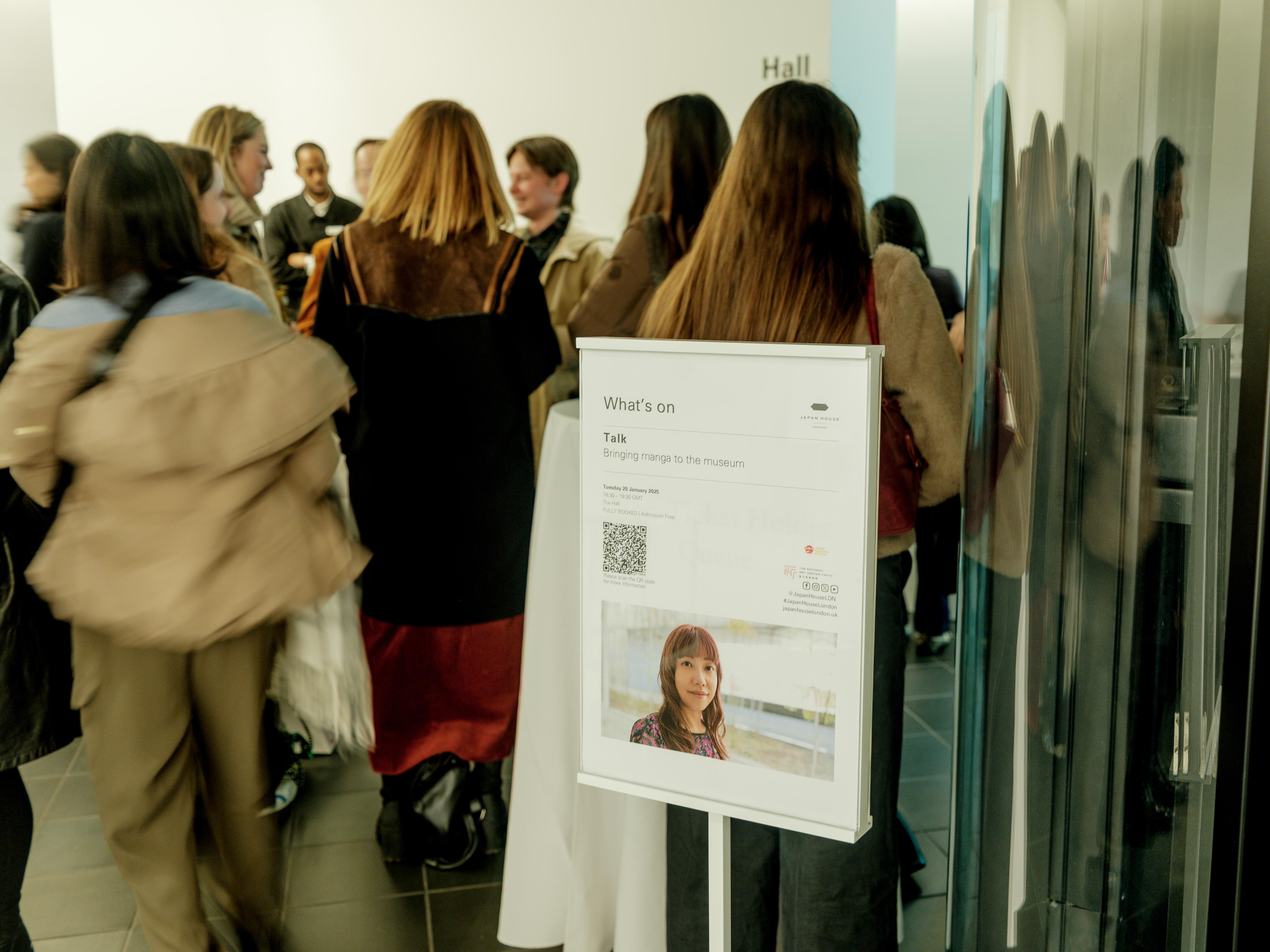 |
Photo: Daisy Wingate-Saul
- Organized by
-
The National Art Center, Tokyo; Japan House London; Japan Arts Council; Agency for Cultural Affairs, Government of Japan